
.png?width=1014&height=1255&name=SEH_Logo_RGB%20(1).png)
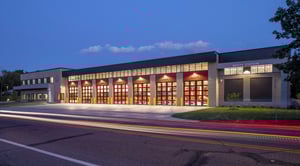
Fire and Emergency Medical Services (EMS) stations are unique workplaces – they are operational hubs, training centers, and homes for firefighters. How crews sleep isn’t just a design detail; it’s a decision that impacts readiness, wellness, and long-term performance. For fire chiefs planning new facilities or renovations, understanding the trade-offs between group and individual sleeping quarters is essential.
Group Sleeping Quarters: Speed and Camaraderie
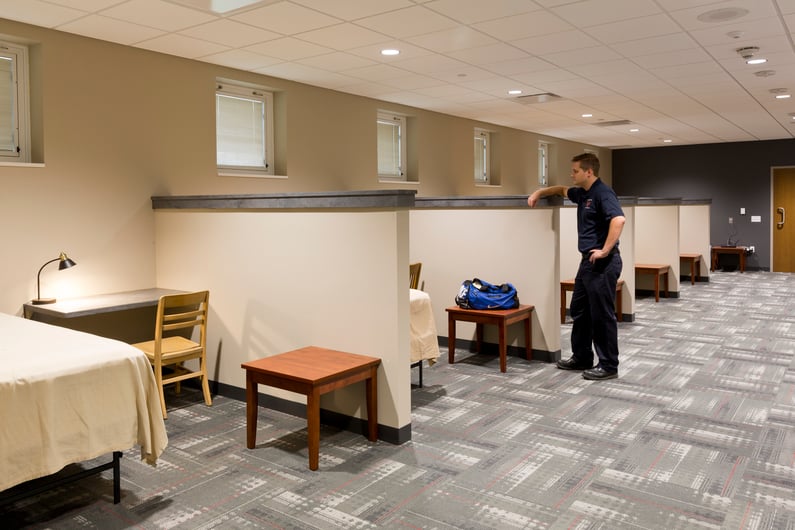
Group sleeping quarters are traditional in many stations, with several firefighters sharing a dormitory-style room. This setup provides:
- Rapid response: Personnel are close to each other and apparatus bays, shaving precious seconds off emergency response.
- Space efficiency: Dorm-style layouts house more people in less square footage, important in stations with smaller footprints.
- Team cohesion: Shared sleeping areas can foster camaraderie, bonding, and a sense of family that is central to firefighting culture.
But there are important drawbacks to consider. Noise, varying sleep schedules, and limited privacy can reduce rest quality, impacting alertness and performance. Shared spaces can also amplify exposure to dust, off-gassing from turnout gear, or other environmental contaminants that fire chiefs are increasingly considering in line with health and safety research. And with more departments moving toward mixed-gender staffing, shared sleeping quarters introduce additional privacy and comfort considerations that leadership can’t afford to overlook when planning renovations or new facilities.
Individual Sleeping Quarters: Privacy, Recovery, and Health
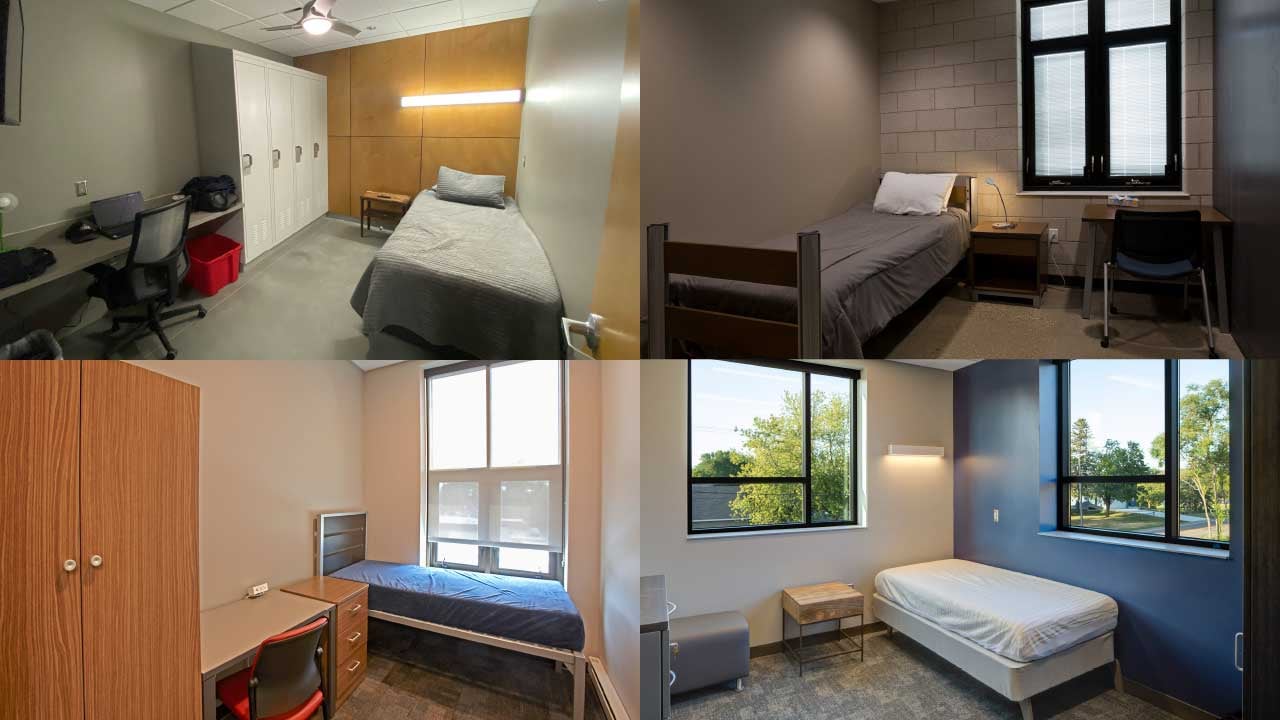
Individual or semi-private sleeping spaces are becoming more common, especially in modern station design.
Here’s what you can expect from this arrangement:
- Enhanced rest quality: Firefighters can control light, noise, and temperature, allowing for deeper, uninterrupted sleep.
- Reduced environmental exposure: Separating sleeping areas limits the spread of dust, PFAS residues, and other contaminants from gear or shared spaces.
- Mental health and wellness: Private or semi-private rooms provide a personal retreat, helping firefighters decompress after high-stress calls.
These benefits come with trade-offs in space, cost, and station culture. Individual rooms require more square footage, additional HVAC zoning, and higher infrastructure investment. They can also reduce the spontaneous, day-to-day social interactions that naturally occur in shared dorms, and can unintentionally encourage isolation when someone is stressed or coming off a difficult call. In some stations, officers have noted a different challenge: Private rooms can make it easier for crew members to slip away during chores or routine tasks. Without clear expectations and regular check-ins, this can chip away at accountability and team cohesion.
For fire chiefs, the task is finding the right balance – designing a facility that supports operational efficiency, strengthens wellness, and still reinforces the teamwork that keeps a station running smoothly.
Making the Right Choice for Your Station
Sleeping arrangements may seem straightforward on paper, but in practice, they shape how a station functions day to day. And because no two departments operate the same way, the “best” sleeping configuration depends on the realities of your staffing model, call volume, facility age, and long-term goals.
Fire chiefs must weigh multiple factors: how quickly crews need to respond, how much space is available, what wellness and recovery standards the department is striving for, and how environmental considerations like dust, off-gassing from gear, or PFAS and other carcinogen exposures impact daily life in the station. The right decision balances these operational, health, and logistical needs while remaining adaptable for future shifts in staffing, regulations, or technology.
Rather than thinking of sleeping arrangements as a static feature, forward-looking departments are approaching them as a tool to optimize readiness and wellness. With careful planning, chiefs can design spaces that enhance sleep quality, reduce contamination risks, and even strengthen team cohesion through thoughtful integration of private and shared spaces.
By evaluating these key considerations, departments can make an informed decision that supports both the short-term efficiency and long-term sustainability of their operations.
Fire chiefs can use a simple set of considerations to guide their decision:
- Operational readiness: Smaller crews may benefit most from group dorms for faster mobilization. Larger stations often have flexibility to incorporate private spaces without compromising response times.
- Wellness focus: Departments prioritizing long-term health and performance may lean toward individual or semi-private quarters to improve sleep quality and recovery.
- Environmental controls: HVAC zoning, noise mitigation, and contamination management should influence whether group or individual spaces are more practical.
- Cost and space constraints: Private quarters require more square footage and investment, which must be weighed against wellness and operational gains.
Hybrid solutions: Many modern stations are blending the best of both worlds. Some pair private sleeping rooms with shared lounges, team rooms or social spaces to maintain camaraderie while improving rest quality. Others use group sleeping areas supported by private pods or partitioned nooks, giving crews the benefits of a shared bunkroom with added opportunities for privacy and decompression.
The Takeaway for Fire Chiefs
Sleeping arrangements in fire stations are no longer a one-size-fits-all decision. Modern design allows chiefs to customize solutions that balance operational efficiency, wellness, and long-term adaptability.
The stations we design at SEH are grounded in these principles. By integrating thoughtful sleeping layouts with environmental controls, contamination mitigation, and flexible common areas, fire chiefs can create facilities that support their crews – not just on the job, but around the clock.
When planning your next station or renovation, the question isn’t just how many beds, but how will your firefighters sleep, recover, and perform at their best? Thoughtful sleeping arrangements answer that question while preparing your department for decades of service.
About the Experts

Chuck (Charles) Leipzig is an operational specialist and former fire chief with extensive experience in emergency services, station operations, and facility planning. In his former role, he led strategic staffing expansions, station consolidations, and major renovation and rebuild projects, including securing funding and overseeing construction for two fire stations in Kenosha, Wisconsin. At SEH, he applies this on-the-ground leadership background to help departments improve efficiency, safety, and long-term performance through thoughtful, operationally- driven station design.

Chris Bowen is an architect and project manager who leads multidisciplinary teams to deliver complex facilities with a focus on quality, efficiency and budget accountability. His work spans commercial, educational, and institutional projects, giving him a strong foundation in designing functional, high-performance buildings. His background in classical and historic architecture adds depth to his design approach, helping him create facilities that are both practical and enduring.
Professional Architect in FL, DE, GA, IN, OH, PA, RI, VT