


For airport planners, the critical aircraft determination is more than a technical exercise. It influences runway design standards, facility recommendations, funding eligibility, and long-range capital planning. Yet for many non-towered general aviation airports, the most difficult part of the process is documenting that use with verifiable data in a way that satisfies current Federal Aviation Administration (FAA) guidance.
Recent planning efforts with the Wisconsin Bureau of Aeronautics (BOA) and the FAA Airports District Office (ADO) have reinforced the need for a structured, transparent approach. Airport sponsors and managers often know that larger or more demanding aircraft are using their facilities. However, the available data does not always capture the full extent of that activity, particularly when operations occur outside instrument flight rules or are not consistently logged through national tracking systems.
As a result, planners are often faced with a difficult question: How do you document aircraft use in a way that meets FAA expectations when no single data source tells the complete story?

Why the Determination Matters
FAA Advisory Circular 150/5700-17, Critical Aircraft and Regular Use Determination, defines the critical aircraft as “the most demanding aircraft type, or grouping of aircraft with similar characteristics, which make regular use of the airport.” Regular use is defined as 500 annual takeoffs or landings, including itinerant and local activity but excluding touch-and-go operations. An operation is either one takeoff or one landing.
Although aviation activity forecasts remain important, current FAA review practices place significant emphasis on validating the critical aircraft and documenting the basis for that determination. At many non-towered airports with lower annual operations levels, this has shifted the focus from broad forecast analysis to a more targeted question: what aircraft are using the airport regularly, and how can that use be reasonably documented?
This determination affects the portion of eligible projects that can be funded through federal and state dollars. In some cases, it can influence an airport sponsor's ability to maintain existing airfield geometry and infrastructure.
The Data Gap at Non-Towered Airports
Most non-towered general aviation airports do not have a reliable method for counting every aircraft operation. Instead, airport sponsors often rely on a combination of:
- FAA Form 5010 data
- FAA Aerospace Forecasts
- Statewide system plans
- Traffic Flow Management System Counts (TFMSC)
- ADS-B-derived datasets
- FlightAware records
- Tools such as 1200.aero
- Airport manager logs
- Sponsor input
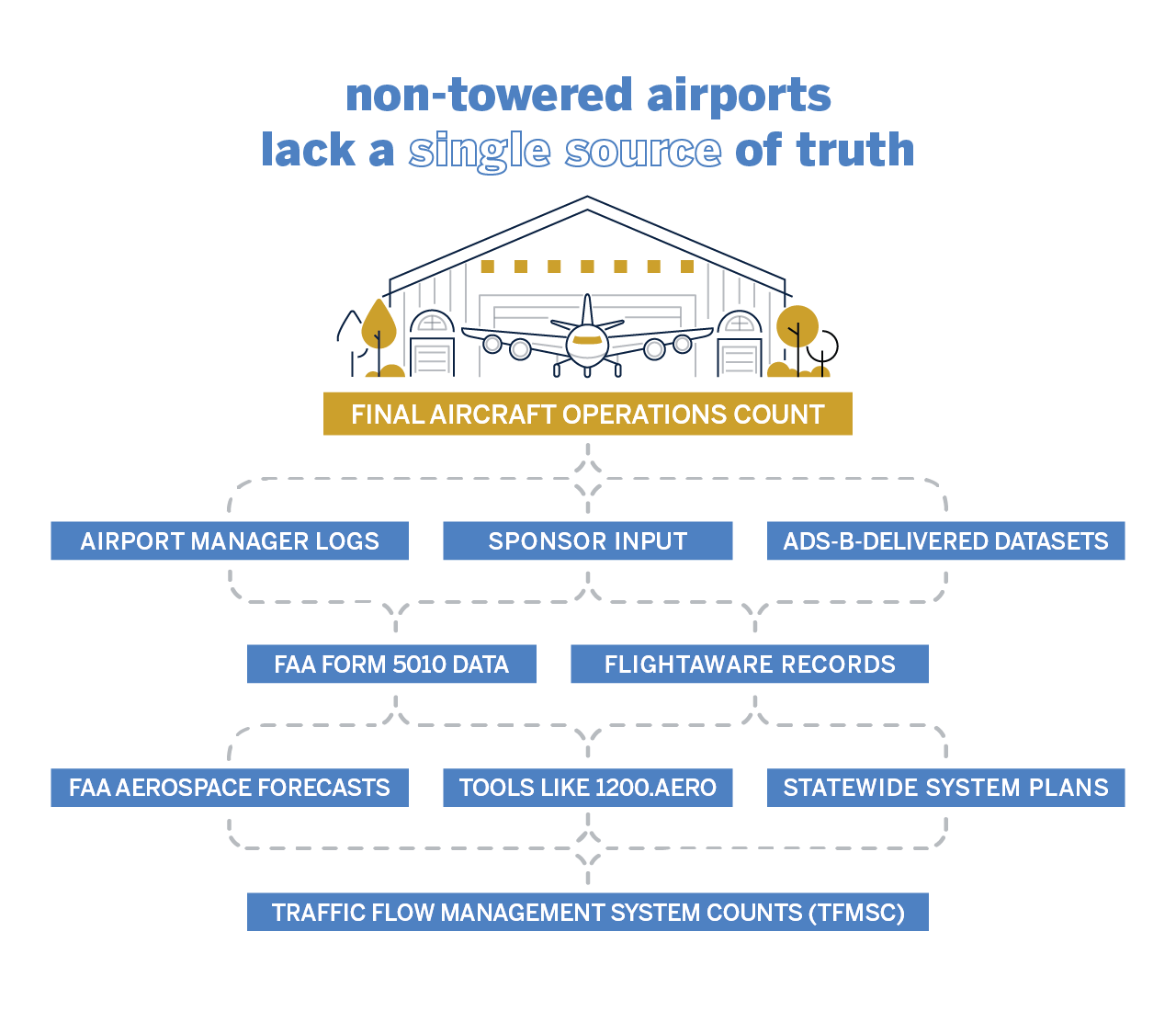
Each source contributes useful information, but each has limitations. Administrative sources can provide helpful context yet may rely on historical assumptions rather than current counts. TFMSC can identify IFR activity and higher-performance aircraft that frequently file flight plans, but it does not capture all visual flight rules activity typically used by pilots of smaller aircraft. ADS-B and flight-tracking tools can improve visibility, but coverage may vary, especially in rural areas. Local records can fill important gaps, but they must be consistent, well documented, and suitable for review.
The challenge is not that data is unavailable. It's that no single source captures the full picture. That makes it important to compare multiple datasets and understand where gaps may exist.
The 500-Operation Challenge
The 500-operation threshold can be especially challenging when observed activity and documented activity do not align. Airport staff may regularly see business jets or other demanding aircraft using the airport, while available datasets show lower operation counts than observed by these aircraft types.
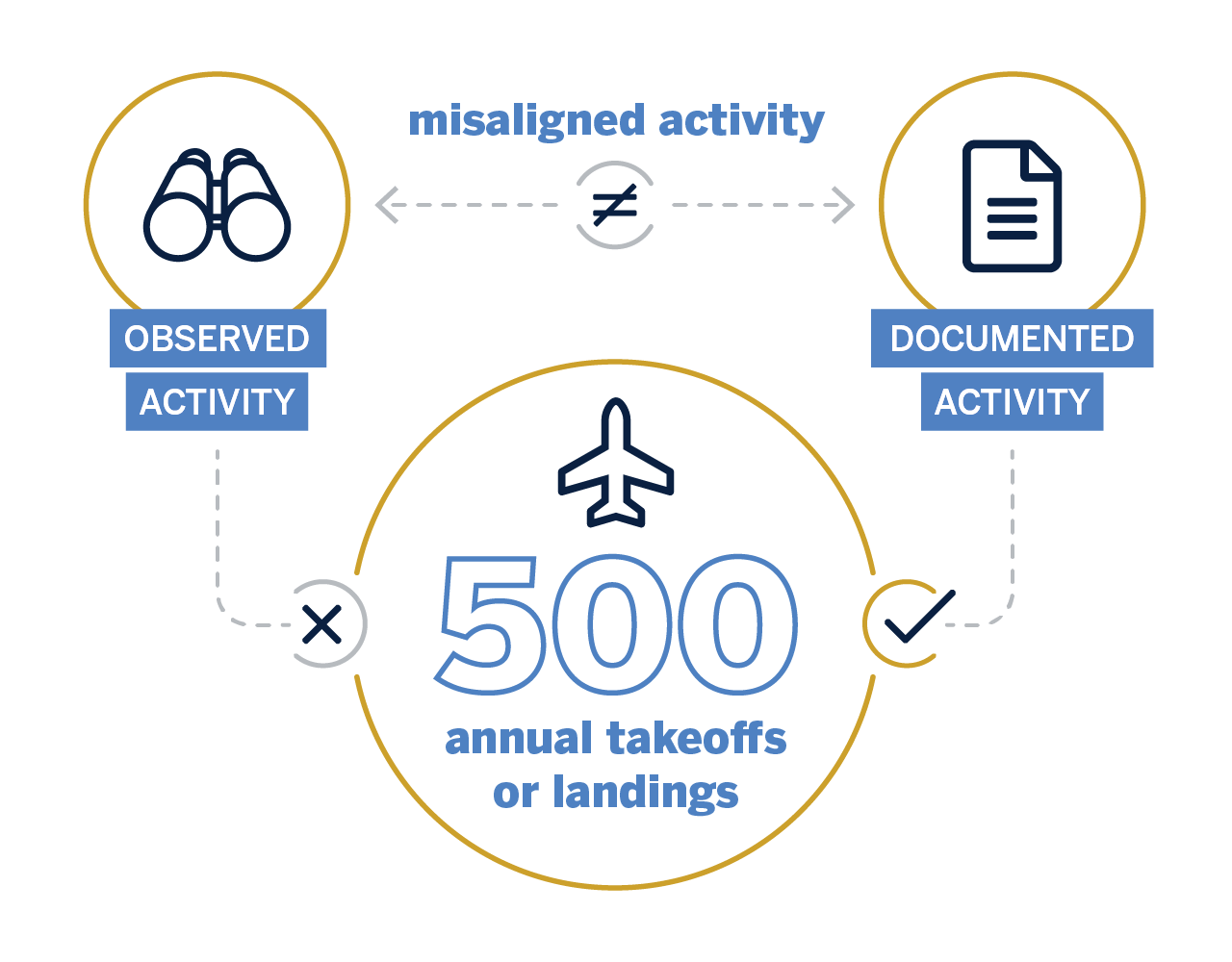
This distinction matters. The critical aircraft determination applies to all runways, not only the primary runway. When the data does not clearly document regular use for a runway, sponsors may face difficulty justifying infrastructure that has historically served specific aircraft types. For this reason, the planning narrative must do more than present numbers; it must explain the context, limitations, and rationale behind the determination.
A Defensible Path Forward
Recent BOA and FAA reviews have underscored the value of a transparent, well-supported explanation. A defensible critical aircraft determination should identify the data sources used, acknowledge known limitations, compare findings across sources, and clearly state why the selected aircraft or aircraft family is the most reasonable planning basis for the airport. The critical aircraft determination should also distinguish between existing, near-term, and mid-term conditions when the anticipated critical aircraft may change over time.
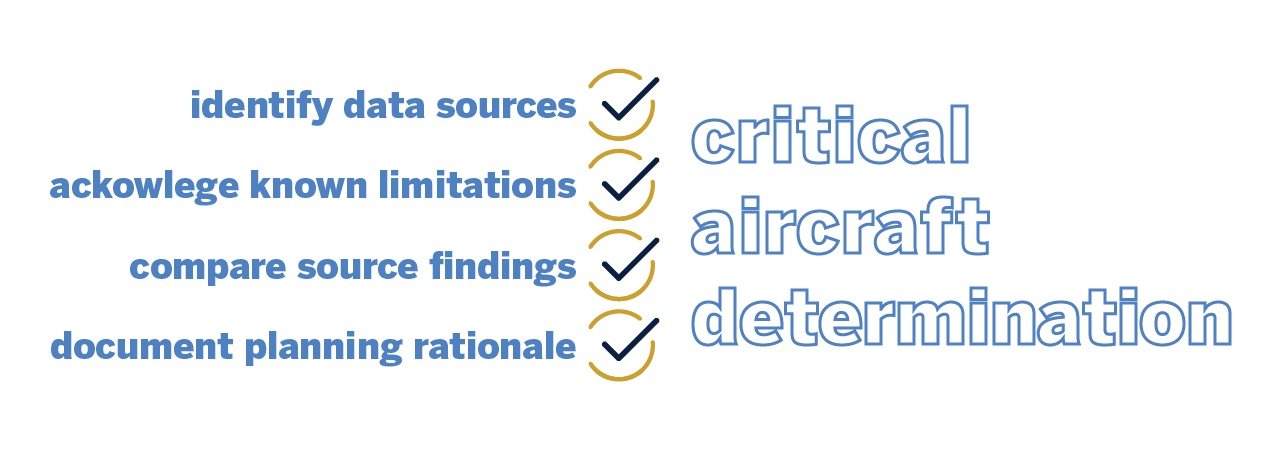
Several practical lessons have emerged. First, no single data source should be treated as complete. Second, local knowledge is valuable, but it should be supported by consistent documentation whenever possible. Third, acknowledging uncertainty is often more credible than presenting false precision. Finally, the purpose of the determination is not to produce perfect data; it is to establish a reasonable, transparent, and supportable planning foundation.
As planners, we've found that the strongest determinations combine quantitative data with well-documented local knowledge. Together, they provide a clearer picture of how an airport is actually being used.
The Case for Better Data
The aviation industry continues to gain access to better operational datasets, improved ADS-B coverage, and more sophisticated analytical tools. These resources will undoubtedly improve the ability to document airport activity in the future. However, challenges will remain, particularly at non-towered airports where no single source captures all activity.
It’s important to start gaining this information now. While covering additional expenses is challenging at many general aviation airports, investing in better operational data today can help support future planning efforts and protect eligibility for available funding. A minimal annual fee can make a large difference to the funding received for future projects and maintaining the existing airport infrastructure.
In the end, the challenge is not simply counting airplanes. It's documenting activity in a way that supports sound planning decisions, best reflects actual airport use, and provides airport sponsors, regulators, and consultants with a common understanding of how the airport functions today and how it should be planned for tomorrow.
About the Expert

Melissa Underwood is an SEH senior aviation planner and project manager of more than 50 projects over the past 10 years. With 25+ years of experience, she understands that any project is possible through precise planning and forward thinking. Melissa has extensive experience in public involvement – working tirelessly to educate stakeholders on the importance of our airports and future airport developments.