
.png?width=1014&height=1255&name=SEH_Logo_RGB%20(1).png)
Challenge
At Camp Ripley in Little Falls, Minnesota, moving heavy military equipment by rail was anything but efficient. The Minnesota National Guard relied on aging rail spurs that cut directly through internal roads and active work areas. Each time tanks, armored vehicles, or support equipment needed to be mobilized, roads were closed, traffic would back up, and crews had to navigate tight quarters shared with rail operations. What should have been a straightforward loadout became a carefully choreographed effort with little room for error.
Space constraints slowed crane and forklift movement and increased the potential for conflicts between personnel, vehicles, and railcars. Limited site lighting further narrowed the operational window. Nighttime and low-visibility loading introduced additional safety concerns, often stretching schedules and extending mobilization timelines. The Guard needed a safer, purpose-built solution that could keep pace with its training and deployment demands without disrupting daily base operations.
Solution
SEH partnered with the Minnesota Department of Military Affairs (MNDMA) and BNSF Railway to design and support construction of a purpose-built rail loading and unloading facility tailored to Camp Ripley’s operational needs. Rather than modifying the existing constrained system, the team helped create a new, dedicated 18-acre rail loading facility strategically located outside the cantonment area. By relocating operations away from the base’s active core, the Guard gained a space designed specifically for efficient, high-capacity mobilization.
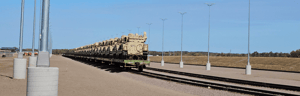
The new facility features four straight, flat tracks, each approximately 2,500 feet long. The expanded alignment allows more railcars to be staged and loaded simultaneously, with clear access along both sides of each track. Crews can now maneuver equipment and combat vehicles safely and efficiently, reducing congestion and eliminating the road closures that once disrupted base activity. Concrete end ramps enable tracked and wheeled vehicles to drive directly onto railcars, streamlining the loading process and reducing handling steps.
In addition to the streamlined process, uniform site lighting, supported by 58 light poles, provides consistent visibility for strapping, inspection, and staging in all conditions. Operations are no longer dictated by daylight, giving the Guard greater flexibility and control over its schedule.
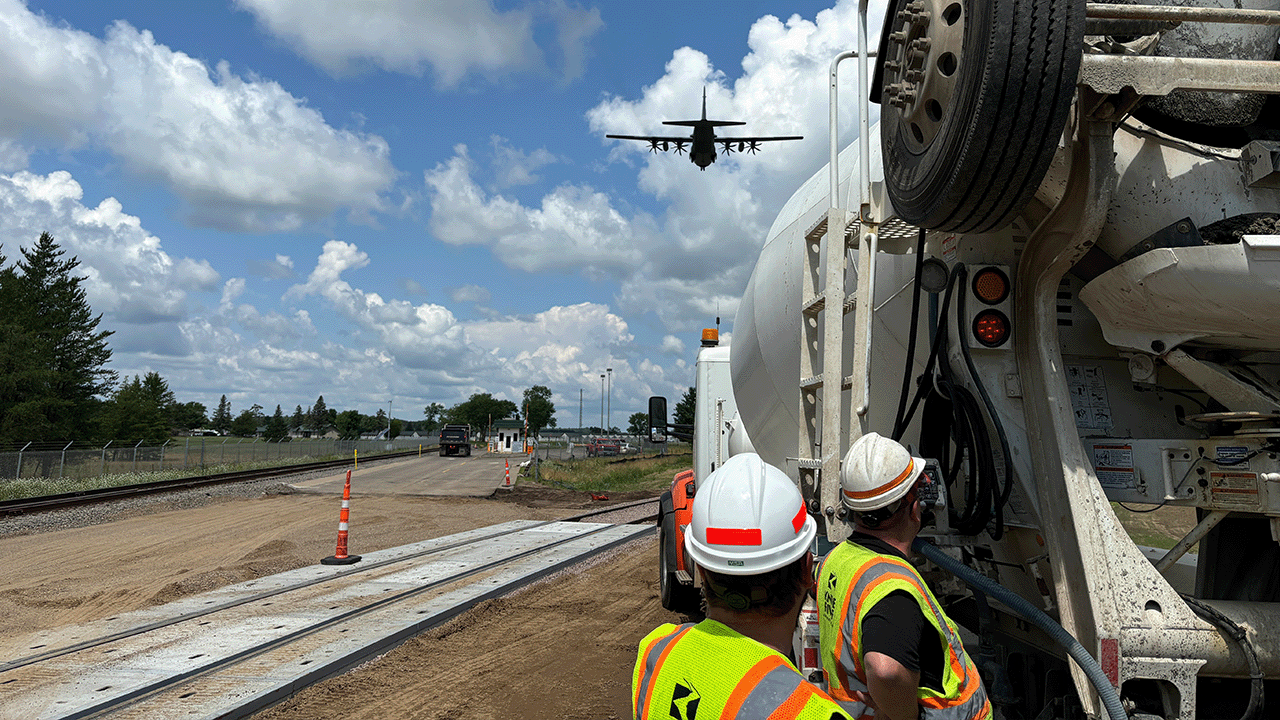
For these improvements, the SEH team provided comprehensive civil and rail engineering services, including topographic surveying, track and site design, stormwater management, lighting, concrete foundations, roadway improvements, and at-grade crossings. Throughout design and construction, the team coordinated closely with BNSF and Camp Ripley stakeholders to meet railroad standards while maintaining uninterrupted base operations. Construction support services helped align field activities with military schedules and contractor sequencing.
Today, the impact is measurable. Equipment loadout time has been reduced from approximately seven days to fewer than three; internal roads remain open, and safety risks have decreased. Most importantly, the Minnesota National Guard now has a purpose-built facility that strengthens readiness, supports faster mobilization, and allows Camp Ripley to operate at full capacity without compromise.
Project
Camp Ripley Rail Spur
Location
Little Falls, Minnesota
Client
-
Minnesota Department of Military Affairs
-
BNSF Railway
Features
- Four 2,500-foot straight rail tracks for simultaneous loading
- 18-acre site with unobstructed crane and forklift access
- Concrete end ramps allowing direct drive-on loading for vehicles
- Lighting system with 58 poles supporting safe night operations
- Loadout duration reduced from seven days to less than three
Services