
.png?width=1014&height=1255&name=SEH_Logo_RGB%20(1).png)
Challenge
Located along the Minnesota River, the City of New Ulm, Minnesota, is a community of approximately 14,000 residents known for its strong German heritage, historic downtown, and extensive parks and public spaces.
Its last comprehensive plan, adopted in 2007, no longer reflected current conditions or the direction of the community. City leaders needed an updated plan that could guide growth, redevelopment, and investment over the next 20 years.
Expansion beyond city limits is constrained, placing greater pressure on infill, redevelopment, and maximizing existing infrastructure. At the same time, the City sought to better align long-term residents and new growth around a shared vision.
Rather than a traditional, high-level plan, New Ulm needed a clear, actionable roadmap. One that identified solutions that could be applied to the city’s four priority growth and redevelopment areas, translated community input into real decisions, and could be easily used by staff, elected officials, and development partners.
Solution
SEH partnered with the City of New Ulm to deliver a visually engaging, implementation-focused Comprehensive Plan that functions as both a planning document and a practical decision-making tool. Adopted in June 2024, the plan guides growth, investment, and development over the next 20 years while connecting community input directly to action.
Engagement That Shaped the Plan
Public participation was not a just step in the process, it drove the outcome. SEH designed a multi-channel engagement approach that combined interactive online tools, in-person events, and focused workshops to reach a broad cross-section of the community and encourage meaningful input. The result was a level of participation that gave the project clear direction and community-backed momentum:
- More than 2,400 residents participated in surveys
- Over 200 ideas were submitted through interactive mapping
- 7 Steering Committee meetings guided recommendations
- 5 in-person events and 2 open houses supported dialogue
All input was shared transparently through an online platform, reinforcing trust and clearly demonstrating how community feedback informed priorities, strategies, and decisions.
To deepen understanding, the team facilitated rapid planning workshops and site visits focused on key areas of growth and redevelopment. These sessions allowed stakeholders to test ideas, explore tradeoffs, and refine recommendations in real time.
A Structure Designed for Action
The plan was intentionally structured to connect:
Existing conditions → Community input → Opportunities → Strategies
Each chapter follows this consistent format, making it easy for users to understand not only what is recommended, but why.
Infographics and visuals translate complex planning concepts into an approachable, user-friendly document for residents, elected officials, and development partners. Recommendations such as mixed-use development, housing diversity, and streetscape enhancements are paired with responses to common concerns, reinforcing how strategies align with community priorities.
A companion brochure extends the reach of the plan, making key direction accessible beyond City Hall.
Focused Planning to Guide Real Development
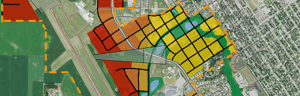
To move from vision to implementation, the plan includes four small-area plans that evaluate priority growth and redevelopment sites.
Each area was analyzed for:
- Infrastructure feasibility and cost
- Development potential
- Compatibility with surrounding uses
- Long-term community benefit
These areas presented unique conditions, including sites outside city boundaries, airport-related constraints, and downtown redevelopment opportunities.
The result is a set of targeted, site-specific strategies that support housing, commercial development, employment centers, infrastructure investment, and public spaces, all aligned with the broader community vision.
Implementation with Accountability
The plan is designed to be used, not shelved.
An implementation chapter establishes priority goals and strategies for each topic area, supported by a matrix that defines timelines and responsible parties. This provides a clear framework for tracking progress and maintaining momentum over time.
The plan is already being referenced in development review and infrastructure planning, demonstrating its immediate value as a tool for decision-making.
Project
New Ulm Comprehensive Plan
Location
New Ulm, Minnesota
Client
City of New Ulm
Features
- 2,400 plus survey participants and 200 plus mapped comments
- Public events and a Steering Committee guiding recommendations
- Clear chapter structure linking community input to strategies and action
- Accessible planning document with rich graphics and plain language
- Small area plans assessing growth, infrastructure, and redevelopment feasibility
- Implementation matrix outlining priorities, timelines, and responsible parties
Services
- Comprehensive planning
- Planning and urban design
- Transportation planning