
.png?width=1014&height=1255&name=SEH_Logo_RGB%20(1).png)
Challenge
For decades, Highway 47 (University Avenue) and Highway 65 (Central Avenue) have functioned as major north–south corridors serving Minneapolis and nearby communities. These roadways play a central role in how thousands of residents reach jobs, schools, transit, and essential services each day. Before converging near downtown Minneapolis, the two parallel highways extend more than 10 miles north, crossing seven cities and two counties. As residential and commercial development grew along the corridors, MnDOT recognized that the existing transportation system was no longer keeping pace with how people actually use these roads.
Residents living near the highways rely more heavily on transit, walking, and biking than the regional average. When paired with dense commercial activity and higher-than-average poverty rates, the corridors’ car-focused design fell short of meeting community needs. MnDOT set out to address this mismatch through future planning and improvements.
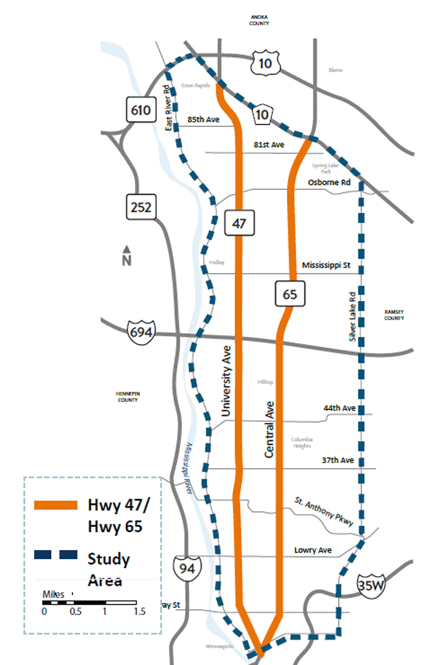
Map highlighting the study area for this project
Many segments of both highways also experience higher-than-average crash rates, with a disproportionate number involving pedestrians and bicyclists, including severe and fatal injuries. Between 2015 and 2019, the crash fatality rate on Highway 47 was seven times higher than the metro average, while Highway 65 experienced twice the average rate. The City of Minneapolis has identified portions of both corridors as Vision Zero high-injury streets, reflecting an elevated concentration of serious injuries and fatalities. While pedestrians and bicyclists were involved in just 5% of all crashes, they accounted for 39% of fatal and serious injury crashes along the corridor—more than ten times the rate for vehicle occupants.
Before advancing any infrastructure improvements, MnDOT recognized the need to better understand the safety challenges along these corridors and how to address them in a way that reflects how people actually travel, particularly residents living in nearby neighborhoods.
Solution
To identify community requirements and inform future improvements along Hwy 47 and Hwy 65, MnDOT conducted a Planning and Environmental Linkages (PEL) study. The goal of the PEL study was to take a holistic approach that robustly engaged the surrounding community in several ways.
During phase one of the study, MnDOT partnered with SEH’s team of experienced engineers and planners to provide community engagement and data analysis. Together, the team's findings helped produce a “roadmap” of needed enhancements to make the highway designs more equitable and designed in a way that is community-driven, multimodal, and safer for all users, including the most vulnerable.
Understanding the diverse requirements of those residing along these corridors was a top priority of the study. To ensure recommended improvements were representative of resident needs, widespread community engagement efforts were initiated to reach community members while respecting new pandemic-era restrictions including:
-
Three virtual open houses
-
256 calls to stakeholders
-
Interactive website which generated over 2,200 comments
-
1,557 survey responses
-
Online interactive map that generated 478 comments
-
30 one-on-one phone interviews with a diverse group of community residents
The results of this robust engagement campaign revealed extensive information about community demographics and what the engaged stakeholders most require in corridor improvements now and into the future. The analysis of stakeholder feedback was combined with the holistic technical analysis of the corridor.
Because the various modes of transportation do not occur in isolation, detailed multimodal analyses were conducted to inform a holistic look at the various issues that impact transportation for each mode alongside the community’s physical, social, and economic elements. This holistic analysis approach was necessary to fully understand the transportation context and identify priorities along the corridor where transportation needs are compounded by land uses such as schools, homes and job centers as well as demographic indicators of multimodal needs which include areas with concentrations of low-income and communities of color.
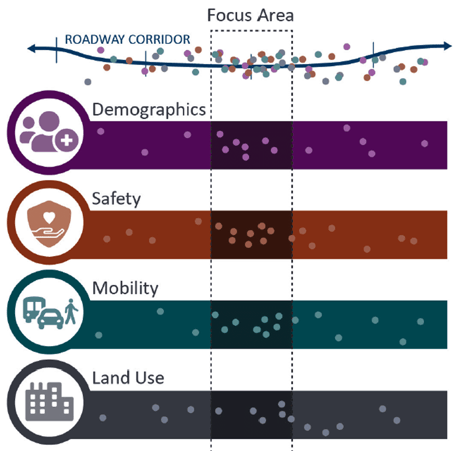
A stacked graphical multimodal analysis highlighting key focus areas
The holistic corridor analyses and engagement data indicated the following for each user group:
-
Pedestrians/Bicyclists: As walking and biking activity increases, priority improvements include more enhanced and shorter pedestrian crossings, gaps filled in sidewalk networks, greater accessible transportation options, and comfortable and safe cycling systems to key destinations.
-
Vehicles: While limited traffic growth is expected, improvements are needed to ease significant crossing delays and provide safer turning movements. Remedies to upgrade safety and decrease delays to cross street traffic and people walking include adjusting signal times and targeted road capacity enhancements.
-
Public transit: Community members indicated a greater dependency and need for public transit. With nine percent of all transit stops currently not connected to sidewalk systems, increasing connections and access (including space for snow clearance) is a priority.
-
Freight: These highways vital trucking routes with over 60 percent of businesses located along the corridor identify as freight-related including the Intermodal facility between the roadways. All improvements considered should account for freight activity to enhance safe and efficient conditions.
Thanks to the valuable insight, data, and analysis found in this comprehensive study, MnDOT and local partners have the knowledge to better understand future project priorities and secure necessary resources to make these highways a safer, more equitable place for all users.
Project
Highway 47/Highway 65 Study
Location
Minneapolis to Blaine, Minnesota
Client
MnDOT North Metropolitan District and MnDOT West Metropolitan District
Features
-
Planning and environmental linkages study
-
Multimodal complete streets improvements
-
Inclusive, robust public engagement campaign
-
Recommendations rooted in holistic analysis combined with community feedback
Services
-
Transportation planning
-
Highway design
-
Traffic engineering
-
Public engagement