
.png?width=1014&height=1255&name=SEH_Logo_RGB%20(1).png)
Challenge
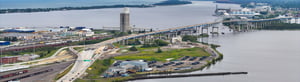
The Twin Ports Interchange project in Duluth required a strategic approach to major infrastructure challenges at the heart of one of Minnesota’s most complex transportation hubs. Serving as the critical junction between I-35, I-535, and TH 53, the outdated interchange faced several compounding issues, including aging bridges, unsafe geometric design, inefficient freight flow, and extensive environmental contamination.
These corridor limitations made it difficult to support modern commerce, especially the heavy truck traffic serving the Port of Duluth-Superior, and posed increasing safety risks for local and regional travelers. The project also required improvements to the I-535/Garfield interchange and careful coordination with city and state agencies, railroad operators, utility owners, and community stakeholders, all while maintaining traffic on one of Minnesota’s busiest tourist and freight routes.


Solution
To address these challenges, the Minnesota Department of Transportation (MnDOT) employed the Construction Manager/General Contractor (CMGC) delivery method. This approach fostered early and continuous collaboration across the entire project team, consisting of MnDOT, Ames-Kramer Joint Venture, SEH, and 16 consultant firms through three separate final design contracts for roadway, bridge, and geotech. This collaborative approach enabled design and construction to progress concurrently through four interdependent work packages, carefully sequenced to minimize disruptions and maximize efficiency. The team addressed design challenges in real time, including maintenance of traffic, ongoing railroad operations, stormwater treatment, and poor and contaminated soils.
One of the project’s most creative solutions was applied to the challenge of maintaining traffic on southbound I-35 during construction. As proposed by AKJV, the idea was to redirect that traffic onto Michigan Avenue, temporarily turning a city street into a full-fledged interstate. It was a bold move that required reinforcing pavement, testing structural strength, and working hand in hand with local businesses and residents to maintain access. However, the payoff was worth it. Traffic kept flowing, freight stayed on schedule, and Duluth remained connected throughout construction.
With a solution in place for the traffic rerouting, the team could focus on the three major highways – I-35, I-535, and U.S. 53 – all converged in one tight area, each with its own engineering demands. Bridge work over Garfield Avenue and the busy BNSF rail lines had to be perfectly timed to avoid interrupting freight traffic. To build a solid foundation for the future, engineers turned to deep foundation systems and advanced soil stabilization methods, ensuring the ground could support what was to come.
Throughout this process, it was clear that protecting the environment was just as important as rebuilding the interchange. The project area sat on land shaped by generations of industry, and with that came a legacy of contamination. Beneath the surface were reminders of Duluth’s industrial past – soils and groundwater that needed careful handling to keep nearby waterways safe. Every decision, from how the soil was excavated to where it could be reused, was guided by environmental studies and a commitment to doing the right thing for the community and the land.
Sustainability also guided the design. Rather than start from scratch, the team found ways to reuse existing bridge foundations at the Garfield Avenue interchange and avoid excavating many of the existing below-ground structures elsewhere on the project. That choice reduced waste, cut down on materials, and limited disturbance to the contaminated soils and surrounding area. Careful attention to wetlands and local ecosystems ensured that natural resources were protected and that the project honored its responsibility to the environment.
With construction complete, what were once hazardous exits and blind merges are now clear, safe routes that make travel smoother for everyone. Freight operators can now move goods more reliably to and from the Clure Public Terminal, reinforcing the Twin Ports’ role as a major shipping hub and supporting long-term economic growth. Beyond mobility and freight efficiency, the project also creates new opportunities for space beneath the bridges, reserving it for community use, including a future public skate park that will transform a once overlooked area into a place for connection and recreation.
This project reflects the power of strategic delivery, innovative engineering, and close collaboration between consultants and industry partners. By navigating complex technical, environmental, and social challenges, the Twin Ports Interchange sets a new standard for regional infrastructure, one that improves safety and commerce while delivering lasting value to the surrounding community.
Awards
- 2026 Operational Excellence, Large Project | Mid-America Association of State Transportation Officials (MAASTO)
- 2026 Engineering Excellence National Recognition Award | American Council of Engineering Companies
- 2026 Grand Award | American Council of Engineering Companies of Minnesota (ACEC-MN)
Project
Twin Ports Interchange
Location
Duluth, Minnesota
Client
Minnesota Department of Transportation (MnDOT), District 1
Features
- Safer, more intuitive traffic patterns and roadway geometry
- Creative Construction staging to maintain traffic flow
- Railroad facility realignment to support project infrastructure
- Realignment of Miller and Coffee Creeks
- Stormwater management and treatment facilities
- Ground improvements to enhance stability of infrastructure
- Use of advanced structural techniques like curved prestressed superstructures
- Improved freight access to and from regional terminals
- Integration of community spaces beneath infrastructure
- Environmental mitigation plan for management of contaminated soils
- Reuse of existing infrastructure to minimize environmental impact
Services
- Project management of the Roadway Final Design Contract and consultant team
- Environmental engineering
- Conceptual and Preliminary highway design (I-535/Garfield Interchange, TH 53)
- Final highway design (I-535/Garfield Interchange)
- Preliminary and final bridge design (I-535/Garfield Interchange)
- Freeway and local road lighting design
- Wetland delineation
- Utility coordination
- Traffic signal design
- Structural metal design
- Construction administration