
.png?width=1014&height=1255&name=SEH_Logo_RGB%20(1).png)
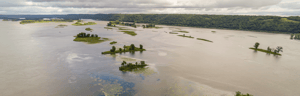
Challenge
The Upper Mississippi River System is one of the most ecologically significant river systems in the country, supporting hundreds of wildlife species across flowing channels, backwaters, wetlands, floodplain lakes, and forested habitats. Within this system, Lower Pool 10 has experienced decades of habitat degradation. Island loss, high hydrologic connectivity, reduced diversity in riverbed depth and configuration, and the decline of vegetation have reshaped the area. Much of this change stems from the Lock and Dam system constructed in the early 1900s, which fundamentally altered natural river processes.
The need for restoration in Lower Pool 10 was clear: rebuild geomorphic features, restore habitat diversity, and strengthen long-term ecosystem resilience within this critical reach of the river.
Focused on restoring habitat conditions in this target area, the project required close coordination among multiple agencies and strict compliance with federal and state environmental regulations. Hydraulic constraints, endangered species and cultural resources protections, as well as navigation considerations, added significant complexity to the design process.
Through the Upper Mississippi River Restoration (UMRR) program, the nation’s first environmental restoration and monitoring initiative of its kind, this vision moved toward action.
Solution
As part of a multi-agency Project Design Team, SEH, along with our small business partner, Himalayan Consultants, helped implement the goals of the Upper Mississippi River Restoration Environmental Management Program and National Wildlife Refuge policies into on-the-ground solutions. The project will reconstruct and stabilize approximately 40 acres of island habitat in Lower Pool 10, reshaping landforms and hydraulic patterns to improve habitat diversity, reduce erosive forces, and support the long-term recovery of native plant and wildlife communities.
The team facilitated a Value Engineering workshop with representatives from the U.S. Army Corps of Engineers (USACE) St. Paul District, U.S. Fish and Wildlife Service, Iowa Department of Natural Resources (IDNR), and Wisconsin Department of Natural Resources (WDNR). The workshop identified performance improvements, constructability considerations, cost efficiencies, and a strategic approach for the beneficial use of dredged material. Recommendations from this workshop were incorporated directly into final design documents to maximize available funding and long-term project value.
Comprehensive Design Across Three Focus Areas
The Lower Pool 10 Habitat Rehabilitation and Restoration Project (HREP) was implemented across three focus areas:
-
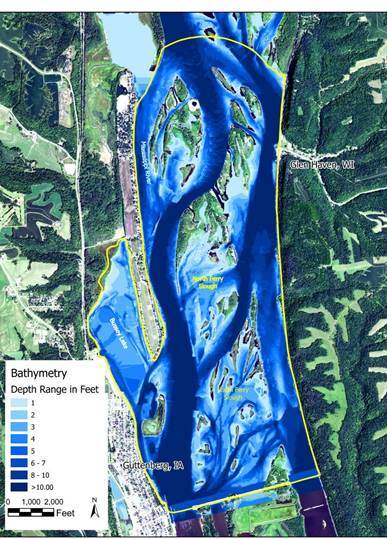
Stage 1: South Ferry Slough Island
-
Stage 2: North Ferry Slough Island
-
Stage 3: McMillan Island
Topographic and bathymetric surveys were completed to fully understand existing site conditions, providing a solid foundation for designing the project features and guiding decisions throughout the design process.
Each stage of the project included a dedicated set of construction documents, specifications, cost estimates, and schedules, providing the client with a clear roadmap for implementation. A comprehensive design documentation report captured the overall approach and highlighted key engineering considerations to support a smooth transition into construction.
The design process adhered to complex environmental and regulatory requirements in line with UMRR program objectives, including the National Environmental Policy Act, Clean Water Act, Endangered Species Act, and National Historic Preservation Act. These requirements shaped the technical approach, ensuring protective measures for bald eagles, northern long-eared bats, federally and state threatened & endangered mussel species, and designated no-work areas. Island elevations and footprints were carefully engineered to meet state No-Rise hydraulic standards, managing flood risk without creating adverse impacts upstream or downstream.
Sustainability
One of the project’s key challenges was balancing earthwork needs with navigation requirements. Following the U.S. Army Corps of Engineers’ beneficial use of dredged material guidelines, granular material from the navigation channel was used to build the structural foundation of the new islands – linking routine channel maintenance directly with habitat creation provides sustainable solutions to ongoing challenges the hard-working Mississippi River has experienced over time.
Once the island footprints were established, fine-grained material from overwintering habitat dredging features was used to cap the islands, creating soil conditions that support vegetation and allow restored plant communities to take root and thrive. The team carefully confirmed borrow volumes, coordinated construction access with ongoing dredging operations, and incorporated stockpiled granular material from USACE Channels and Harbors. This approach not only strengthened sediment transport capacity but also supported natural land-building processes along the channel edges, ensuring the islands’ long-term stability and ecological function.
Restoring Habitat Diversity and Resilience
The permanent features were designed to reestablish the riparian border between secondary channels and adjacent backwaters, while rock structures and erosion protection elements enhanced bathymetric diversity and seasonal water level variation, translating into overall water quality improvements.
The restored system delivers a variety of habitats that benefit both wildlife and people:
-
Shallow lentic habitat to support aquatic species
-
Semi-lotic wetland habitat to support diversity of mammals, amphibians and birds
-
Newly created and restored island habitat to benefit terrestrial species, native and migratory bird species
-
Deep-water fish overwintering habitat to increase winter survival of aquatic species
-
Fisheries, recreation and ecotourism opportunities
By improving hydro-geomorphic conditions and ecological function, the project enhances both the quantity and quality of habitat for native species and migratory birds, while strengthening the long-term resilience of the river system.
With an estimated construction value of $40 million, the Lower Pool 10 Habitat Rehabilitation and Restoration Project is the largest Upper Mississippi River Restoration effort to advance to construction, marking a significant investment in the river’s future and the communities and ecosystems it supports. SEH’s support of the U.S. Army Corps of Engineers on this effort reflects the firm’s commitment to innovative, sustainable restoration and advancing resilient, lasting environmental solutions.
*Drone photography courtesy of USACE, St. Paul District
Project
Upper Mississippi River Restoration: Lower Pool 10 Habitat Rehabilitation and Restoration Project (HREP)
Location
Guttenberg, Iowa
Client
USACE – St. Paul District
Features
- Multi-agency collaboration advancing Upper Mississippi River Restoration program priorities and National Wildlife Refuge policy objectives
- High-impact Value Engineering workshop driving performance gains, constructability innovation, and cost efficiency
- Comprehensive three-stage habitat rehabilitation across South Ferry Slough and McMillan Island focus areas
- Fully integrated environmental compliance strategy protecting sensitive species and meeting federal regulatory standards
- Precision surveying, design, cost estimating, and scheduling, enabling seamless implementation
- Innovative, beneficial use of dredged material transforming navigation byproducts into stable, vegetation-ready island foundations
- Restoration of 40 acres of resilient island and aquatic habitat, strengthening hydro-geomorphic stability and ecological diversity
Services
- Survey
- Water resources engineering
- Geotechnical engineering
- Civil engineering
- Natural resources
- Geographic information systems