
.png?width=1014&height=1255&name=SEH_Logo_RGB%20(1).png)
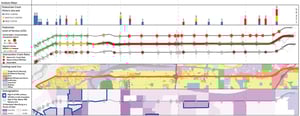
Picture a typical aging community corridor. Vehicles move steadily through daily commutes adjacent to parked cars outside the coffee shop, cafes, and gym. A parent navigates a stroller across a wide intersection to the nearby park. Without a dedicated lane, a young cyclist threads through traffic. A bus stops where riders wait along the small grassy boulevard, adapting to a space never designed with them in mind.
Each of these moments is happening at the same time, in the same place. And together, they tell the real story of how a corridor functions and where improvements are needed.
Today’s transportation decisions require a clearer view of that full picture. Communities are balancing safety, growth, equity, and mobility while competing for limited funding and constrained public right-of-way. That means understanding not just how people move, but how people moving interact, where they’re going, and what land use and demographic conditions shape their choices.
Holistic transportation analysis brings those elements together. Instead of looking at individual elements in isolation, it allows agencies to see how travel behavior, land use, safety trends, and community context interact along a corridor. The result is a shared understanding of priorities that reflects how the corridor is actually used and where investments will have the greatest impact.
How Traditional Transportation Analysis Has Typically Worked
For decades, transportation corridor studies have followed a structured, step-by-step approach. Analysts often examined each travel mode independently, with motor vehicle operations evaluated first, followed by separate sections for bicycles, transit, and pedestrian activity. Broader considerations such as land use context or equity were addressed where data and scope allowed.
This approach brought clarity and order to complex projects. It allowed teams to focus deeply on specific systems, apply well-established performance measures, and move projects forward efficiently. It was practical, repeatable, and aligned with the tools and data available at the time.
Over time, however, understanding and expectations around safety, access, mobility, and funding outcomes have evolved. When key elements are analyzed primarily in isolation, relationships between analysis results may not fully emerge until later phases. That can mean safety concerns, accessibility challenges, or community priorities are identified after design concepts are already taking shape. Addressing those considerations late in the process can create added complexity for project teams and frustration for stakeholders.
Importantly, this is not the result of poor planning. It is simply a reflection of an approach developed in an era when transportation goals and evaluation criteria were more narrowly defined.
Different Way to Understand a Corridor
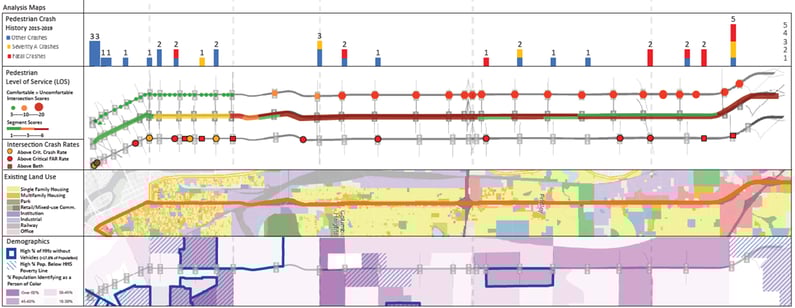
Holistic multimodal analysis, on the other hand, flips the process. For instance, instead of asking how each mode moves and summarizing results independently, it asks how everyone moves – and why. It pulls together multimodal mobility, land use patterns, demographic considerations, safety, and other corridor-specific elements in one place. When those layers stack, the corridor’s complex needs become impossible to ignore.
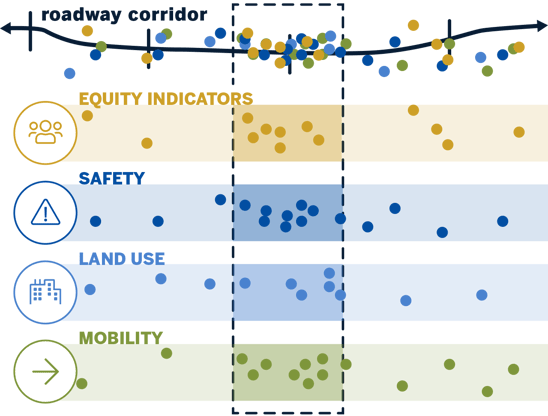
SEH’s approach takes enormous swaths of technical analysis and distills them into patterns clients can fully realize and actually act on. Modes aren’t separated. Equity isn’t a sidebar. The final product tells a story about how the corridor really functions and where improvements will make the most significant difference. We more readily identify locations where transportation needs are compounded by land uses such as schools, homes, and job centers, as well as demographic indicators of multimodal needs, which can include areas with concentrations of senior citizens, cost-burdened households, and underserved communities.
Clients get clarity through early identification of trouble spots, understandable visuals that guide conversations, and confidence that the path forward supports transportation needs, community goals and funding expectations.
What This Looks Like in the Real World
County Highway 42, Dakota County
When Dakota County began reevaluating the future of County Highway 42, their goal wasn't to jump straight to expansion. They wanted to understand what the corridor actually needed.
Locations with the highest future traffic volumes in addition to safety considerations and pedestrian bike needs
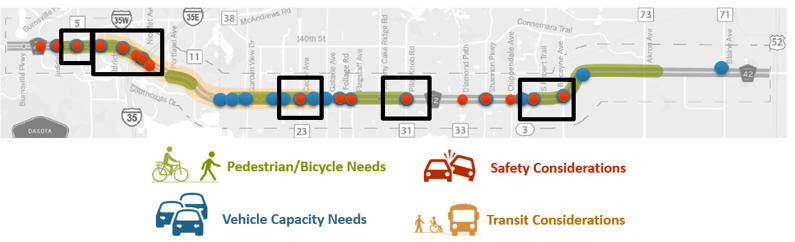
The analysis quickly revealed a corridor with high pedestrian activity, a concerning crash history, and communities with diverse and cost-burdened households who relied on walking and transit.
As such, the project wasn’t about “adding capacity.” It was about identifying targeted improvements where people were already moving, living, and working. The County could invest where it mattered, not where assumptions pointed. A small shift with a big payoff.
Hwy 47 & 65 PEL Study
Another similar but broader story unfolded across two parallel ten-mile segments along state highways, encompassing an area with 145,000 residents.
Data showed high multimodal activity, significant crash patterns, and communities where vehicle ownership wasn’t a given. When the layers of pedestrian crashes, bike access challenges, equity indicators, public feedback, and land use pressures came together, the same areas kept surfacing.
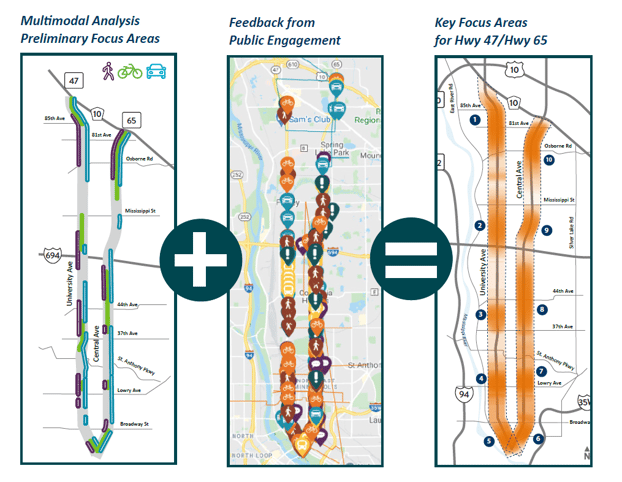
Those overlapping patterns weren’t coincidences. They pointed to the same underlying
issues and showed exactly where the investment would deliver the greatest benefit for the
most people. With a holistic analysis perspective, the corridors essentially highlighted their own priorities.
Why This Matters for Funding
Federal investment programs like the Better Utilizing Investments to Leverage Development (BUILD) Grant Program, Safe Streets and Roads for All (SS4A), and Highway Safety Improvement Program (HSIP) now require more than traditional traffic studies. They prioritize safety improvements, outcomes, multimodal access, and economical solutions. Projects that can’t show meaningful benefits in these areas simply don’t score well.
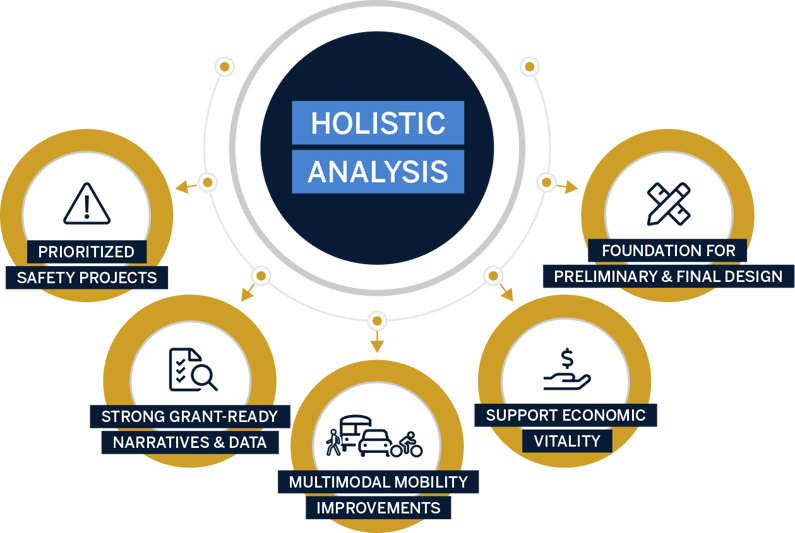
Rather than attempting to piece together a narrative about safety, land use, or demographics for a funding application after the fact, the analysis was integrated from the start. Holistic analysis gives communities a strong, evidence-backed narrative that clearly defines priorities and aligns directly with what grant reviewers notice.
Questions Every Community Should Be Asking
At this point, every agency evaluating a corridor should pause and ask a few honest questions:
- Do we actually understand the factors influencing safety along the corridor?
- Do we know who depends most on walking, biking, and transit, and where they are headed?
- What early insights improve our odds of securing funding?
- Are we equipped to communicate this story clearly to the community? To agency stakeholders? To elected officials?
If the answer is anything but yes, the corridor is trying to tell you something, and a holistic approach will help you hear it.
About the Expert

Heather Kienitz, PE*, is a senior traffic engineer and Multimodal Mobility Market Leader with experience shaping inclusive transportation solutions. She has spent nearly three decades leading multimodal projects to improve safety and access for people walking, rolling, biking, taking transit, and driving. She also contributes to local and national best practices, including coauthoring the 2022 National ITE Crosswalk Policy Guide, developing the 2023 MNDOT Guide for Establishing School Zone Speed Limits, instructing MnDOT Complete Streets workshops, and contributing to MnDOT’s 2021 Best Practices for Pedestrian and Bicycle Safety.
*Registered Professional Engineer in MN